
 Medically Reviewed
Written by Pooja Rawat, Medical Content Writer
Posted On: 17 Oct 2026,
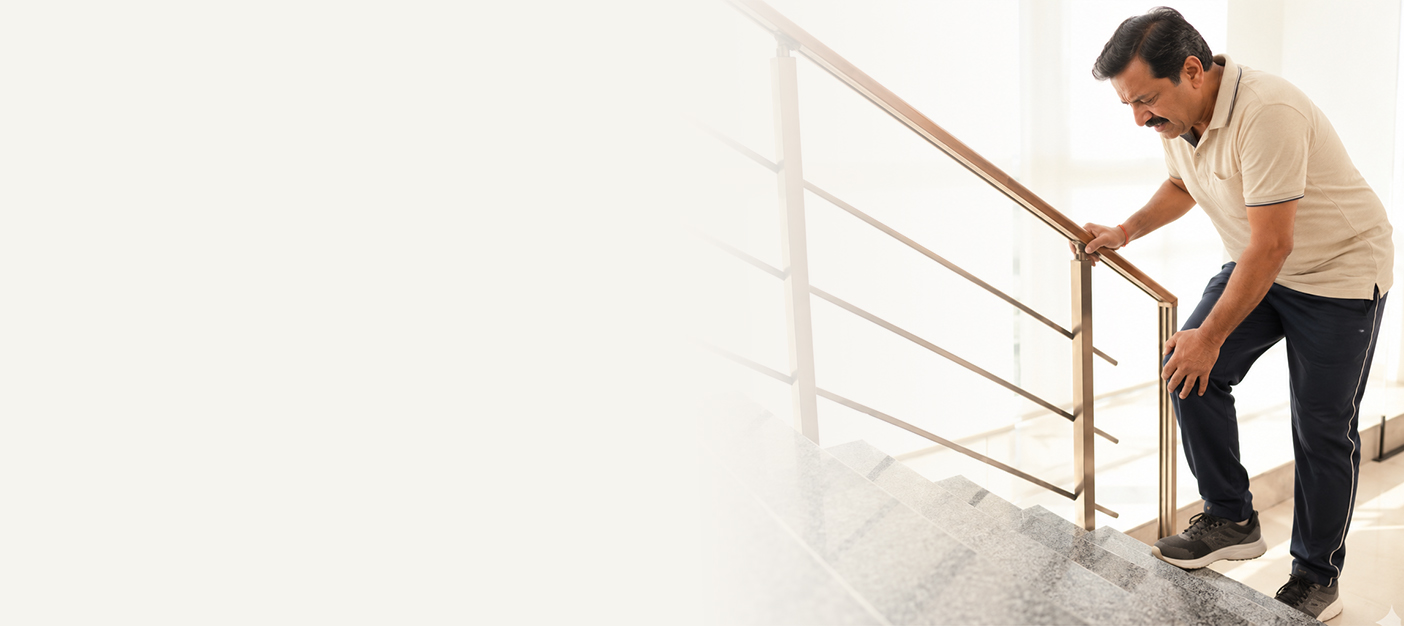
Knee pain while climbing stairs is often experienced by people whose knees are already affected by an underlying condition like patellofemoral pain syndrome, osteoarthritis, muscle weakness, previous injuries, and inflammation.
When you are climbing stairs, there is an additional load on your knees than when you are walking on flat ground. This is because you need to bend your knees more deeply while supporting your body weight. Concern arises when the pain persists for longer than two to three weeks and is accompanied by swelling or locking.
Wondering how it starts?
The symptoms usually do not appear suddenly. You may be climbing the stairs at a metro station, in your office, or at home when you first notice a mild discomfort in your knee. Over time, the pain gradually worsens, and before long, climbing stairs becomes something you dread because you know it is going to hurt.
If you have been experiencing this problem lately, you're not alone. Knee pain while climbing stairs is one of the most common reasons for orthopaedic OPD visits in India. Book an appointment with Dr Ishwar Bohra to know what is causing your knee pain and to explore the various treatment options available.
Yes, climbing stairs does affect the knees. Many people notice that their knees hurt more while climbing stairs than when they are walking on a flat surface.
In a 1972 study by Reilly and Martens, published in Acta Orthopaedica Scandinavica, the duo pointed out that the joint between the kneecap and the thigh bone takes about three times your body weight when you are climbing stairs.While walking on a flat surface, the load is roughly half your body weight.
It is important to understand that this does not mean that stairs are bad for you, and you should not use them. In fact, climbing stairs counts as a physical activity and the WHO itself recommends 150 to 300 minutes of moderate physical activities and 75 to 150 minutes of high intensity physical activity every week.
This extra load shows up as pain and discomfort in people who already have irritated, worn or injured knees.
Yes, your weight does matter, as obesity is considered a leading risk factor for various musculoskeletal conditions, including arthritis. This is because the extra weight you carry is eventually borne by your knees. A 2005 study by Messier and colleagues in Arthritis & Rheumatism showed that losing just 1 kg of body weight reduced the load on the knee by 4kg with every step.
The cause of knee pain while climbing stairs varies, depending on which part of the knee has been affected.
| Condition | Where it hurts | What it feels like | Who gets it |
| Patellofemoral pain syndrome | You experience pain in the front part of the knee, especially around the kneecap | The pain aggravates when you are using stairs, scooting, or after sitting for a long span of time | Teenagers to mid-40s, active adults |
| Knee osteoarthritis | You experience pain in either the inner side of the knee or the whole knee | People suffering from it are likely to experience morning stiffness, along with pain while using stairs and a grinding sensation. | Mostly above 45 years |
| Meniscus tear | the pain can be experienced in the inner and outer edge of the joint | Catching, locking, pain when twisting | Any age |
| Patellar tendinopathy | Pain is experienced just below the kneecap | Pain when the tendon is loaded | Active adults, sportspeople |
| Quadriceps tendinopathy | Pain may be felt just above the kneecap | Pain when pushing up a step | Older adults |
| Ligament injury (ACL, MCL) | The pain is felt deep inside the knee | Feeling that the knee gives way | After sports or a fall |
If you have been experiencing pain around the kneecap, there are high chances that patellofemoral pain syndrome (PFPS) is the culprit. According to the American Academy of orthopaedic surgeons, vigorous activities, including climbing stairs, is one of the main causes of PFPS. It affects the area where the kneecap glides over the femur, preventing smooth movement.
People suffering from PFPS often complain of pain while climbing stairs, squatting and sitting with their knees bent. Some may even complain of unusual clicking or crackling sounds from the knee.
Another common reason why people experience knee pain while climbing stairs is knee osteoarthritis. The condition is caused by the thinning of the smooth cartilage that cushions the knee joints. Joint pain along with stiffness and movement related problems are some of the main symptoms of osteoarthritis.
For people suffering from osteoarthritis, not only climbing stairs, but taking apart in normal day-to-day activities, and even simply walking can be a huge challenge.
It is commonly seen in elderly people, however, it may also be caused by previous injuries, excess body weight or underlying joint related condition.
People suffering from osteoarthritis are quite likely to experience knee pain when taking part in any physical activity, stiffness when they are sitting for too long, frequent swelling or tenderness, clicking or grating sensation and difficulty in climbing stairs.
The meniscus is a C shaped pad of fibrocartilaginous tissue that helps to absorb any unnecessary shock and distribute the load between the femur and the tibia to protect the knee joint.
A meniscus injury, or tear, can impact the knee by causing pain and swelling. It can also accelerate joint wear and tear, causing pain and swelling.
People suffering from a meniscus injury are likely to experience knee pain during movement, swelling, feeling of catching or locking and difficulty in bending or straightening the knee due to which climbing stairs also becomes very difficult.
Knee pain while climbing stairs may also be experienced by people who have weak leg muscles. Strong quadriceps, gluteal muscles, hamstrings and calves, are all important for supporting your knees as these affect how any impact is distributed through the knee.
Weak muscles can contribute to front knee pain, difficulty in climbing stairs, reduced balance, and increased fatigue.
Excessive workload on the tendon surrounding the kneecap can lead to complications like Patellar tendinopathy and quadriceps tendinopathy.
Some common symptoms of tendon injury include pain below or above the kneecap, tenderness and pain during physical activities, especially those that involve bending of the knee like climbing stairs.
When and where you are experiencing pain can actually help your doctor understand the underlying cause and the severity.
When you’re climbing up the stairs, your quadriceps push your body upward. In most cases, the pain is linked to patellofemoral pain, weak thigh muscles, and early arthritis.
When you are going downstairs, your thigh muscles, especially the quadriceps, are in action. In such cases, the pain may be caused by patellofemoral pain, patellar tendon pain and meniscus problems
Clicking knee when climbing stairs is a common problem, and in most cases it is harmless. This is commonly known as crepitus. As long as the clicking is not painful, there is no need to worry. However, In case of pain, discomfort, locking of knees and feeling that knees are giving way, it is important to see a doctor.
Diagnosis of knee pain, while climbing stairs involves detailed evaluation of the patient’s medical history along with physical examination and some imaging tests.
Doctors start by evaluating your medical history and asking questions related to pain and other symptoms.
A physical examination is then conducted to look for any swelling or tenderness. Doctors may also examine the hips and ankles.
Your movement will be assessed during which doctor will carefully the observe how you are walking and taking steps
MRI may be recommended in selected cases where the doctor suspects a problem with the meniscus, ligament, cartilage, or tendons.
Treatment of pain in the knee joint while climbing stairs varies, depending on the underlying cause. Patients are usually recommended a personalised treatment plan that involves lifestyle, changes, medication, and physiotherapy. In extreme cases, the patient may need a knee replacement surgery.
In order to reduce stress from the affected knee, doctors advise patients to avoid vigorous movements that can increase pain, use proper stair climbing techniques and take part in low impact physical activities. Complete inactivity is usually not recommended unless advised by the doctor.
The aim of physiotherapy and exercise is to build strength and strengthen the muscles to support the joints. According to the NHS, exercise is one of the most important treatments for osteoarthritis. An expert physiotherapist can help prepare a personalised physiotherapy program that suits your overall well-being.
The right exercise programme depends on the underlying cause of pain. Exercises should ideally be performed under professional guidance, especially when pain is persistent.
Doctors often recommend people suffering from knee pain while climbing stairs to lose weight as excessive body weight can put an additional strain on the knees and cause wear and tear. Keeping your weight under check can help to reduce the unnecessary pressure on knee structures, improve mobility and reduce any discomfort associated with degenerative joint diseases like osteoarthritis.
The main aim of the medication is to help with the symptoms. Doctors may recommend pain relieving medication, anti-inflammatory medicines, local treatments, and supportive devices.
Not every person experiencing knee pain while climbing stairs needs surgery and is only recommended for those who are not responding to other treatment. Doctor may recommend surgery when the symptoms are not improving with non-surgical methods, There is significant structural damage and the condition interferes with normal data activities
Pain on stairs can have several causes, and a proper diagnosis is the first step towards the right plan. Dr Ishwar Bohra sees patients with knee and joint problems such as pain on stairs, clicking, swelling and difficulty walking.
At the OPD, Dr Ishwar Bohra takes a detailed history, examines the knee, and advises tests only when they are needed. Every finding is explained in simple language so you can take part in decisions about your care.
OPD and consultation details
Experiencing knee pain while climbing stairs means that your kneecap joint, cartilage, meniscus or a tendon is under stress. The best way to resolve this is by getting yourself evaluated. Book a consultation with Dr Ishwar Bohra on +91-9582280201 To know what is causing your knee pain and how you can manage it.
Your knees hurt only when you climb stairs because the moment puts an additional strain on the kneecap and cartilage as compared to walking on a flat surface.
Yes, knee pain on stairs can be a sign of arthritis. However, it can also be associated with several different conditions like kneecap pain, meniscus injury and tendon problems.
Clicking of knees is commonly known as crepitus. It is a harmless condition, however, medical intervention may be needed if it is accompanied by swelling, pain and locking.
Climbing stairs does not necessarily harm your knees. In fact, it is a very good exercise. You just need to make sure you're using the right technique and not overdo it.
You should see a doctor for knee pain on stairs, if the pain and other symptoms last for more than 2 to 3 weeks.
This article is for educational purposes only. It is not medical advice and does not replace diagnosis or treatment by a qualified doctor. Results vary from person to person, and no outcome can be guaranteed. Please consult a registered medical practitioner about any health concern, and do not delay seeking care because of something you read here.

Staying abreast with the latest information is the best way to combat diseases in early stages and live a healthy life. Read the latest news & updates here to learn about the recent advancements in joint care and therapeutics.